MouvementInk · 835 N Lombard, Portland OR · Launching Fall 2026
Eagle
Portland
The brief
Most bar websites are a poster with a phone number. This one is a system — built for what actually happens running a venue, not what a template assumes happens.
Eagle Portland needed to survive the real mess of a working bar: recurring nights that repeat forever until they don't, a guest list that has to remember one person across a dozen different forms, and a search footprint that can't depend on someone remembering to update a meta tag by hand. Built through MouvementInk on Next.js, Sanity and Vercel — not proposed, shipped.
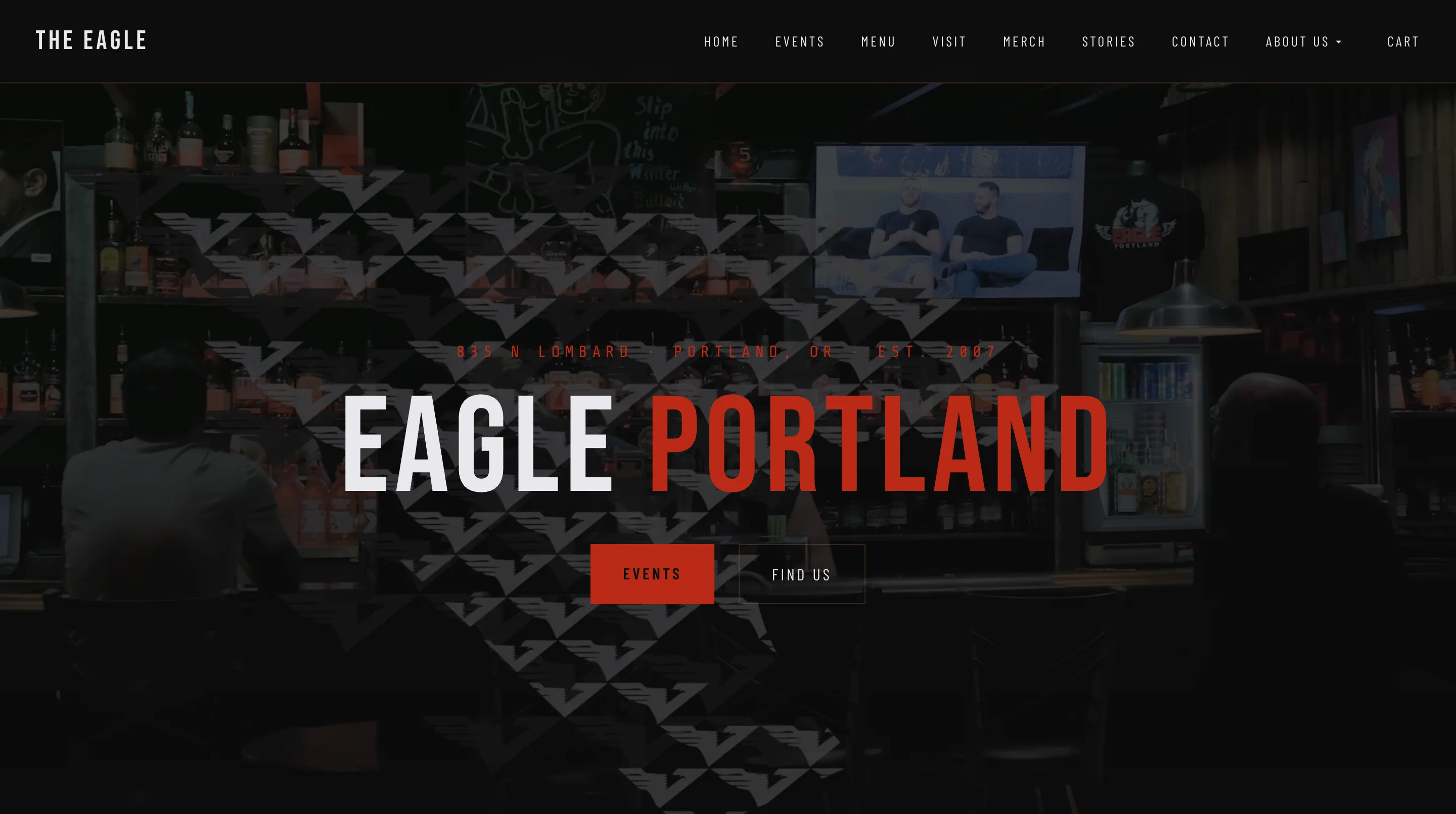
Rolling event expansion window
0
Recurring nights expand into real calendar dates, live, on a rolling basis.
01 / 04
Special-event page templates
0
Default, Poster, Timeline, Custom — one CMS field switches the whole layout.
02 / 04
Custom content types in the CMS
0
Structured editorial control, not a generic page builder.
03 / 04
Deterministic ID, per real customer
0
One person, one record — never three rows that happen to share an email.
04 / 04
The event
engine
System 01 — Recurring nights, done right
Staff pick a night and a cadence in plain language — "every other Tuesday," "last Sunday of the month" — and the site turns that into real calendar dates, correctly, for as long as the night keeps running.
A recurring night is stored once — an anchor date plus a rule — and expanded server-side into a rolling 90-day window of real occurrences. Biweekly nights re-align to the anchor event's own week, so a night created on a Tuesday stays locked to that Tuesday's cadence instead of drifting. Every date resolves against the venue's own timezone, not whatever server happens to render the page.
// Sanity's date field is timezone-less — this pins every
// occurrence to 835 N Lombard, not the server's clock.
const VENUE_TIMEZONE = 'America/Los_Angeles'
export function dateKey(d: Date): string {
  return new Intl.DateTimeFormat('en-CA', {
    timeZone: VENUE_TIMEZONE,
  }).format(d)
}
Ships correctly across DST, timezones, and legacy recurrence rules.
A single template field switches the entire page layout: Default for a standard night, Poster for a full-bleed hero with a configurable overlay, Timeline for a multi-round tournament, Custom for a one-off page that needs its own shape entirely. One CMS, four genuinely different page shapes, zero custom code per event.
One field decides the entire call to action per event: informational only, a free in-house guest list, an external ticket link, or both at once.
Capacity is staff-editable, but the submit path doesn't yet stop RSVPs once a night is full — a wired field, not yet an enforced cutoff.
The client
directory
System 02 — One guest, one record
Every guest who RSVPs, joins the list, or fills out the contact form should be one person in the system — not three unrelated rows that happen to share an email address.
Every client's ID is a deterministic hash of their email — not an auto-incrementing number. An RSVP, a contact form and a bulk spreadsheet import from the same person all resolve to the same record automatically. For the harder case — same person, different email — the system doesn't guess: a name-and-phone match only flags a possible duplicate for a human to confirm.
Zero-duplicate identity for the common case, human judgment kept for the ambiguous one.
Every unsubscribe link is signed with HMAC-SHA256 and verified with a timing-safe comparison, not a plain equality check that can leak the correct signature to an attacker one character at a time. No token table to maintain — the link verifies itself against a server secret.
Any staff member can flag a guest as barred; only an admin can lift it. Every action is designed to create its own incident record — who did it, when — not a boolean that silently flips.
The underlying client dataset is being rebuilt following a security-driven reset, and the door check-in flow is mid-migration to the new data layer — this system is designed and shipped, not yet back in daily use.
A custom, admin-gated tool lets staff drag in a legacy spreadsheet and import it as real client records — reusing the same identity logic as the live site, so a bulk import can't fragment the directory the way a naive CSV import would.
The SEO
layer
System 03 — Show up, and look right
A bar's website should show up when someone searches for it, and look right the moment someone shares it — without a developer touching a meta tag by hand for every new event.
A single boolean governs the sitemap's disallow rules and every page's indexing behavior at once. Launch readiness is a content decision, not a code deploy — the exact mechanism behind the site's current pre-launch state, ahead of the Fall 2026 public launch.
Every page ships real schema.org JSON-LD — venue details, individual events with parsed pricing and cancellation status, breadcrumbs — generated server-side from the same content editors already fill in. Everything is escaped before injection so a pasted character can't break out of its own script tag.
Social preview images generate at request time — page-specific image first, then a site default, then a branded fallback rendered live at the edge. Nothing on the site can be shared with an empty gray box where the image should be.
The brand
system
Identity — archetypes, color, poster language
Eagle carries fifty-plus years of leather-bar and queer-nightlife heritage, and no Eagle bar anywhere in the world had ever turned that into a real visual system — every one of them runs on community loyalty and a rotating flyer, nothing more. The identity built for Portland runs four layers deep: retro athletic Americana, leather heritage, gay ephemera and underground print culture, and a holographic/cyber-underground finish over all of it. Different events draw from different layers, on purpose.
Six color systems anchor it — Holographic/UV, Oil Slick, Liquid Chrome, Acid Green, Kodachrome Amber, Blue Steel — each one keyed to a recurring archetype (the Pool Shark, the Leatherman, the Bear, and so on), so "run it in Oil Slick" is a complete creative brief in three words. Typography locks across every event — four fonts, fixed roles, never swapped — while color and imagery are what actually change week to week. Special occasions get their own one-off take instead of borrowing from the six — Pride, Halloween, NYE and the like each earn a custom palette (Liquid Gold, Obsidian, and others), used once and retired rather than folded into the regular rotation.
Foundation — six near-blacks, one base
Not one black — a family of near-blacks, each pulled as the deepest shadow stop of a color system above it. Which one (or two) becomes the fixed institutional base is still an open call, not yet locked.
Six systems, six archetypes — a persona, not a lock
The Jock
Holographic / UV
Mesh shorts, tube socks, no shirt — the 70s gym-rat figure who wears the house colors because he shows up for everything.
The
Leatherman
Oil Slick
The founding archetype — leather heritage made human, petroleum-dark iridescence.
The Pool
Shark
Liquid Chrome
70s athletic build, tube socks, at the billiards table — print-clean and institutional, the Naked Pool Championship's figure.
The Rubberman
Acid Green
Techno-era, industrial, the darkest archetype — less anatomy, more silhouette and surface.
The Bear
Kodachrome Amber
Broader, bearded, relaxed authority — the only fully analog system, no VHS treatment.
The Alley
Figure
Blue Steel
Biker jacket, streetlight, always backlit — he arrives, he doesn't pose.
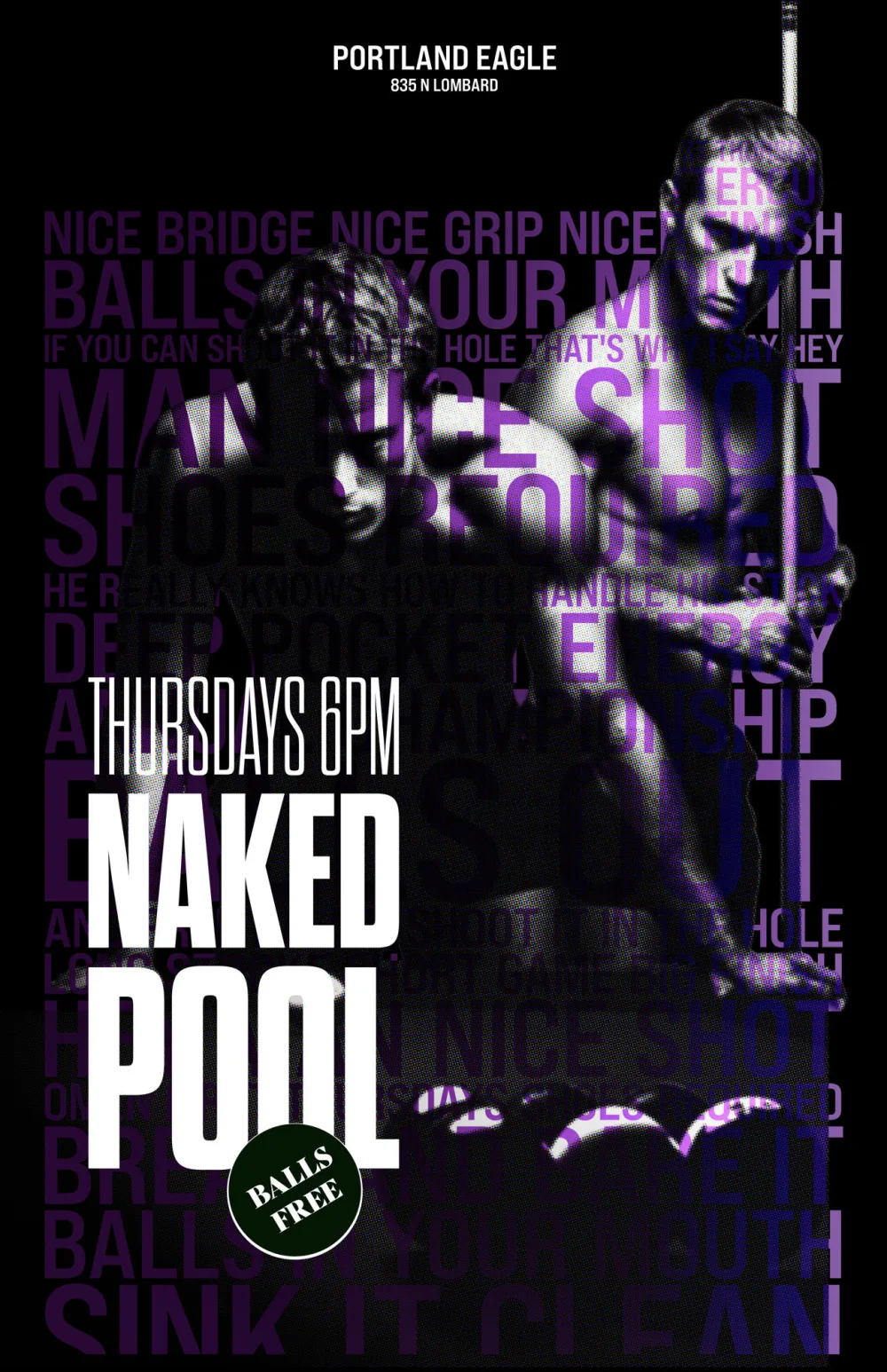
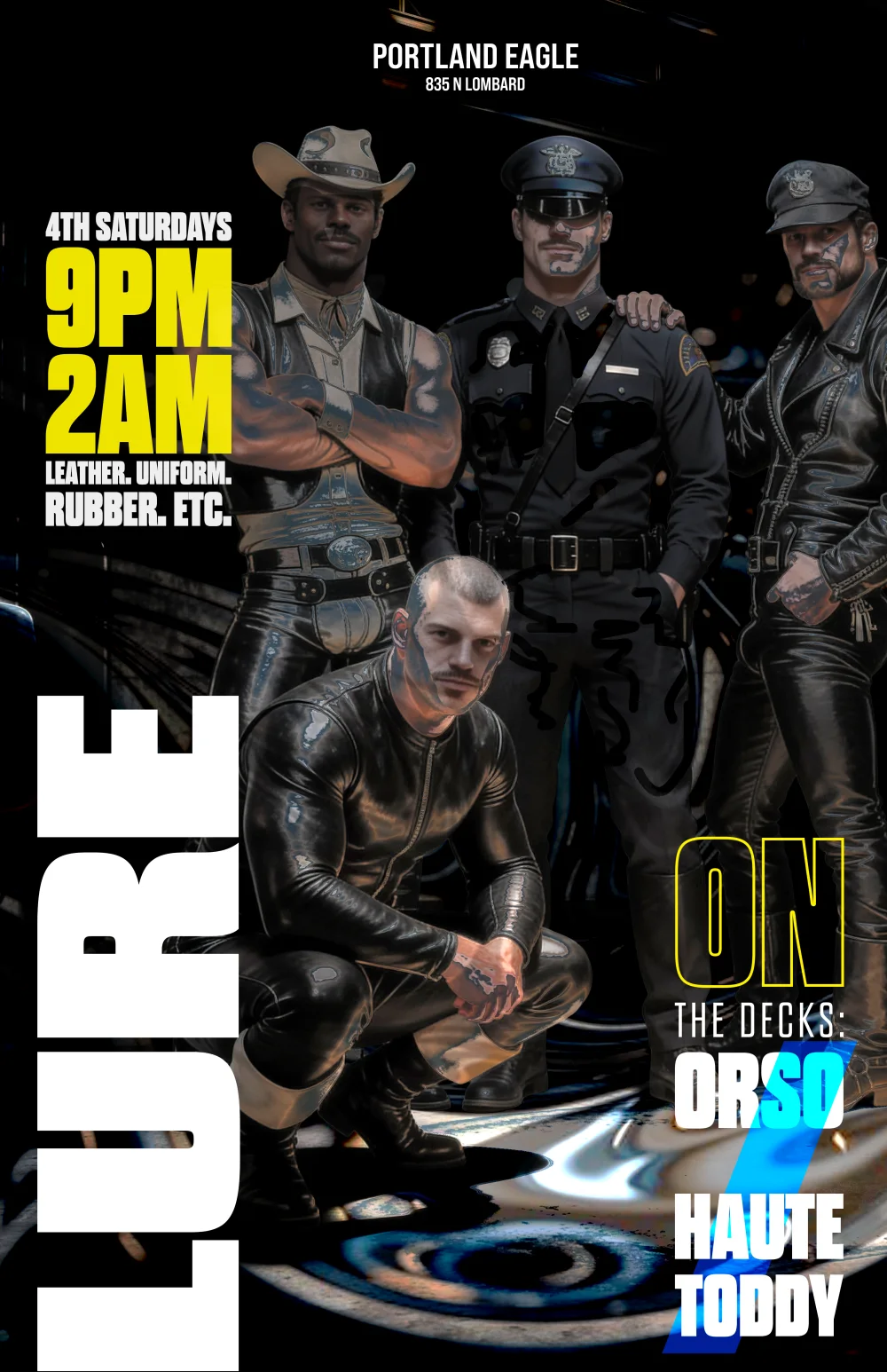
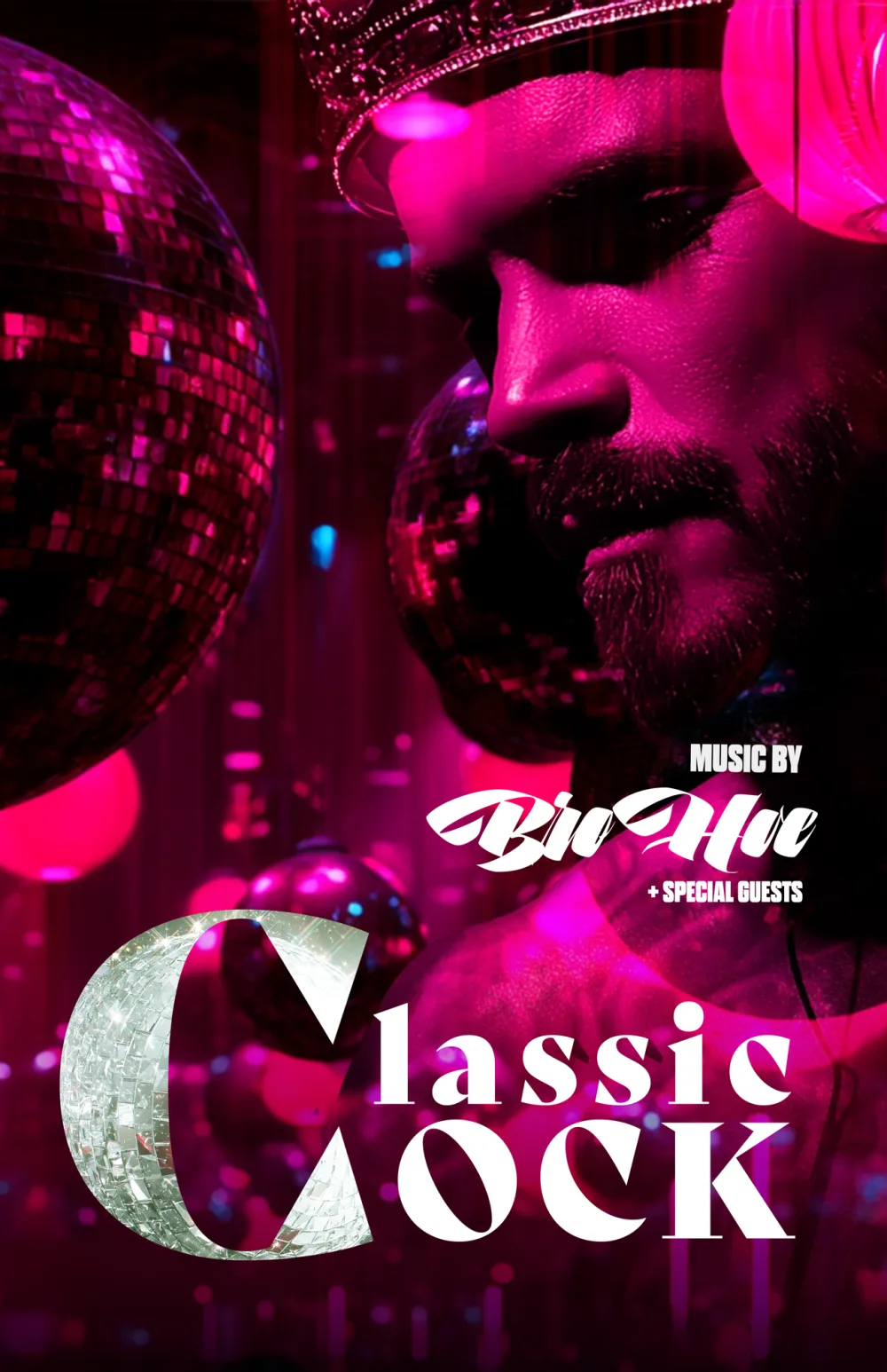
Three structural templates cover the entire real weekly line-up — S.I.N., Growth, Classic Cock w/ Bro Hoe, The Locker Room, AWOO!, BRIEFD — so a new night gets a poster that belongs to the system on day one, not a one-off. The goal, stated plainly in the brand doc: Eagle's flyers should become collectible over time, the way the bar itself already is.
The mark system — the actual logo — is still in development; two identity marks are built (a circle badge, a hand-drawn Eagle icon) but the full ranked system isn't locked yet. Posters and color system are live; the logo is the one piece still catching up.
Role
Built through MouvementInk. Brand identity — archetypes, color systems, typography, poster language — plus systems design, CMS architecture and the SEO layer. Next.js, Sanity, Vercel.
Status
Built and running, not proposed — in a deliberate pre-launch state ahead of a Fall 2026 public launch. This is a preliminary write-up; case study will expand once the site is public.